Effortless continuous improvement
Your agency has outgrown its operations. And now you’re planning a large, all-hands initiative to fix it.
Don’t do it.
Here’s what I am seeing across all my engagements: Over time operations become complex and messy. Up to a point where it feels like a big, daunting task to fix them. Projects are being drawn up, consultants are being hired, to finally get things in order.
Then, when the problems have been analyzed, solutions designed, you train your team on them. Everybody likes it, things “make sense” and “look great”.
And then, one of two things happen:
No change at all.
Or initial change, that either doesn’t stick or new problems creep in.
Regardless, the results are not sustainable.
Solving problems isn’t building operations.
Here’s what’s actually going on.
If your focus as the CEO is on firefighting, it trickles down to your team. Say you have your weekly accounts meeting where you work through all of your clients with the team members that are responsible.
This client is unhappy, do this. That client is about to churn, do that. This automation didn’t work. Touch up the output.
Your team sees and follows the pattern of fixing the issue at hand.
Or worse, you fix things for them.
After a while of doing this, they resort to you as the fixer. For guidance, for solutions, for actions to take.
There’s operational debt piling up. At first you hardly notice. But a few more clients and team members in, your capacity to decide and resolve these issues reaches its limit.
Now you start a one-off initiative to fix things. The team engages, and you find causes and design solutions that work. (That is, if you even get there: I see many improvement initiatives stall or get deprioritized before they even produce tangible results.)
But once you implement, your team resorts back to the habit of waiting for your guidance.
So either they don’t autonomously adopt new solutions at all, or previously adopted solutions aren’t improved and adjusted over time.
So you’re in the same place just weeks or months after the improvement initiative.
Continuous improvement as part of delivery
What I’ve learned across 3 businesses I’ve built, and over 70 client engagements: Operations don’t break in a day. You also can’t fix them in a day.
I’ve tried these project-based improvements myself. And they didn’t work. Glossy deliverables are being admired, just to let them disappear in a drawer right after. Never to be seen again.
Instead, what works is regularly improving stuff for the long-term right when it breaks.
I worked for a large ecommerce brand that had built very deep knowledge of the marketplaces they were on, alongside efficient AI and automation tools to run their operations.
They wanted to build an agency to offer their expertise and tech stack to other brands as a service.
When I came in to build that agency, there was hardly anyone on the team who had worked in B2B service before. They were technically brilliant, but lacked the operational and relationship skills necessary in service.
Instead of doing a large project to define these things and roll them out, we started serving clients. We met daily with the whole delivery team to talk through all client accounts.
Whenever an issue popped up, we did two things:
- Decided how to solve it in this specific instance.
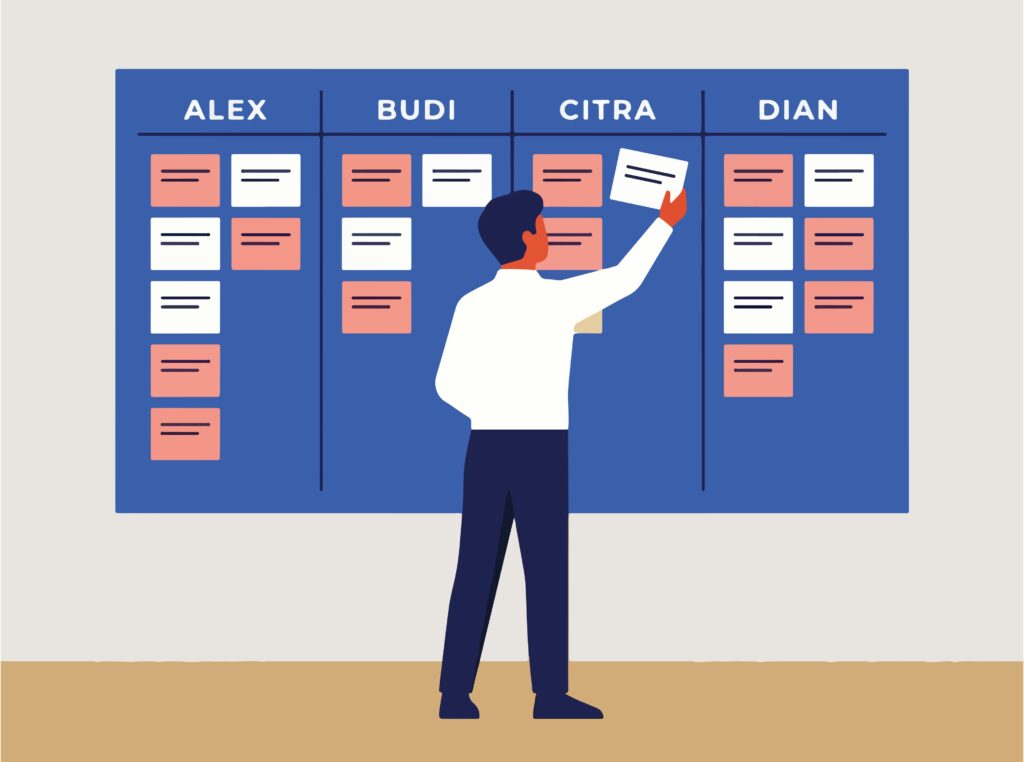
- Added a task to an Asana board to build out the infrastructure, toolset or best practices to avoid it from happening again
We split these meetings in half: 30 minutes client accounts, 30 minutes going through the improvement initiatives.
The beauty about this setup: You get to surface issues, assign them, track completion, and then monitor and drive adoption, all in the same meeting. Alongside resolving stuff that’s urgent, you’re slowly building your infrastructure.
After two months, we changed the cadency to three times a week, then to weekly.
The outcomes were great. Churn decreased, client results and satisfaction increased drastically.
You effortlessly build out and improve your agency operating system. The problem at hand needs to be fixed anyway, so the added step of codifying or building a long-term solution is marginal effort. Your team members are already in the right context.
And most importantly, you establish the way of thinking you need to get out of the weeds. Team members will naturally start asking themselves: How do I fix this for good? And they know it’s on them to design and roll-out the solution.
Don’t solve problems. Train problem solvers.
So in a nutshell: If you feel your agency has outgrown its operational systems, start adding a continuous improvement component to your delivery meetings.
For every issue that happens, assign the responsibility to build a long-term solution to a team member.
Your task as the CEO becomes to follow through with the completion of these tasks, and monitor and drive adoption. All in the same meeting.
This way, continuous improvement becomes a natural extension of your delivery and operations, not a daunting and expensive one-time exercise.