All of my clients — agencies and service businesses alike — are investing heavily in technology to improve service and reduce labor cost.
Several of them were also growing fast. That meant planning future headcount while factoring in efficiency gains from technology.
Here’s the process I use. And the problems I run into.
Matching growth projections with workflow automation
To forecast headcount in these dynamic scenarios, you need to combine three things:
- Process and manual labor
- Technology rollout and its impact on manual labor
- Sales and retention forecast
Process and manual capacity
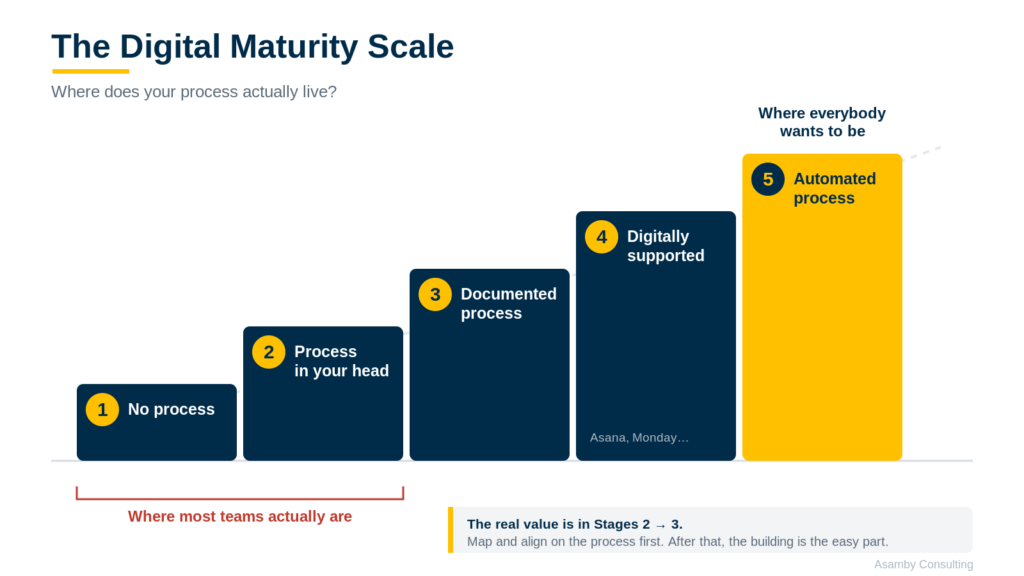
Start by mapping your process. Write down each step. Assign each step to the role that executes it. Then document the current manual workload, ideally per week and per client account.
Use time-tracking data when you have it. Otherwise, use estimates but start tracking now.
Technology rollout
Next, map your planned product and automation rollout over the coming months.
For each process step, project the manual workload per client for each month. Specifically, document the expected reduction in manual work from new product features.
If needed, add a take-rate estimate: what percentage of clients you’re signing will actually use this service?
Tally up the adjusted manual workload per month and per role. This gives you the net bandwidth you need per role for one client account.
Sales and retention forecast
Take that bandwidth per role and account. Multiply it by your projected client count (new clients minus churn) for each month.
This gives you total net bandwidth needed at any given point.
Last step: adjust for unbillable time. Translate net bandwidth into gross bandwidth.
Example: you need 60 hours per week from a specific role. But you can realistically only bill 75% of your team’s hours. That means you need 80 hours of gross bandwidth — two full-time people in that role.
Once this is done, you have a forecast that combines automation rollout with sales projections and gives you required headcount.
Real-world challenges to this approach
Reality is messier than any model. Here are the issues I run into regularly.
Forecasting is guessing
Any forecast is a guess. You could be off by 10% or by 10x. Accept that. Use the model to understand business dynamics, not to predict the future. Adjust frequently based on the latest data.
Product will be delayed
Your product and technology rollout will be delayed. You’re running a service business, not a world-class product organization.
Getting a feature to work the way you need it takes iterations. Often more than you expect.
That means the reduction in manual workload arrives two to three months late. Which means you might need more headcount in the meantime.
Product might not have the expected impact
When your automation goes live, it might not cut manual delivery time by 75%. Maybe it only cuts 25%. These things happen. Your model needs to absorb that.
Adoption takes time
When new tech becomes available, don’t expect instant adoption from your delivery team. Their first priority is serving clients well. They may hold off on using new tools until a milestone is hit, a month is closed, or a deliverable is shipped.
Budget a few weeks for adoption to take hold.
Parkinson’s Law
As you automate tasks, your team frees up time. In the short term, watch where that bandwidth goes.
Chances are your team has a backlog of client work they’d do if they had the time. Now they do.
Parkinson’s Law applies: work expands to fill the time available. So make sure you have new accounts ready to absorb the freed-up capacity. Otherwise, efficiency gains on paper never reach the bottom line.
Delivery overhead outweighing efficiency gains
As core delivery tightens up, you may see a counterintuitive effect: better delivery lets you sign more complex clients.
More complex clients mean more time on hard-to-automate tasks like strategy and account management. So while core delivery hours drop, overhead workload increases. The net efficiency gain? Zero.
Watch for this pattern. It’s common.
Continuous improvement is the key to impactful technology rollout
The takeaway is simple. Revisit your tech-to-headcount mapping monthly and adjust three things:
- Product roadmap: when will each feature actually be available?
- Manual labor projections: how much time does your team actually spend on tasks with current and future technology?
- Sales and retention forecast: how many clients will you service each month?
If you do this consistently, the tech-to-headcount mapping becomes an invaluable tool to steer your service business through growth and automation at the same time.